Testimonials
Students telling their stories.
Application Deadlines:
On-Campus Program:
Fall 2027: July 15, 2027, 11:59 PM ET
Note: There is no spring admission for the on-campus program.
Online Program:
Spring 2027: December 15, 2026, 11:59 PM ET
Fall 2027: July 15, 2027, 11:59 PM ET
Every student’s path into data science is different, and these stories reflect the opportunities that begin at UConn. Through their experiences, students and graduates offer a personal look at how the program helps them grow, build skills, and move toward their goals.
Student and Graduate Voices
Featured Testimonials

Alexander (Alex) Jones, Online Master of Science in Data Science, Graduate Summer 2026
“If you're looking to pivot in your career but you’re scared of taking the leap, I would not hesitate. The MSDS program is great. The faculty are great. The opportunities are great. The whole point of the program is to get you ready and give you all the skills that you need to be qualified for a job in data science… It's great for all kinds of people with all different kinds of backgrounds, and it allows you to switch careers quickly.”
Filling the Gap Between Science and Business
“If you're looking to pivot in your career but you’re scared of taking the leap, I would not hesitate. The MSDS program is great. The faculty are great. The opportunities are great. The whole point of the program is to get you ready and give you all the skills that you need to be qualified for a job in data science… It's great for all kinds of people with all different kinds of backgrounds, and it allows you to switch careers quickly.” — Alexander (Alex) Jones, Online Master of Science in Data Science, Graduate Summer 2026
Accelerating His Career Leap
Beginning his career path in biology, Alexander (Alex) Jones found himself gravitating toward the analytical side of that work. Curiosity sparked, Alex dove into self-learning journey online. This is when he discovered his passion for data science, particularly predictive model building. Recognizing that his learning would be accelerated with the support of an established university and faculty, Alex enrolled in the Online Master of Science in Data Science (MSDS) at the University of Connecticut (UConn). Throughout his time in the program, Alex embraced his aim to take full advantage of the abundant opportunities for professional growth, enhancing his skills as he forged new connections. Having now graduated, Alex feels fully prepared with the tools he needs to be successful as he leaps into his new career as Associate Data Scientist.
Crossroads: biology or data analytics
A Connecticut local, Alex attended UConn for his undergraduate degree, earning his BS in Molecular and Cell Biology, with a minor in Mathematics. Amidst his early experiences in biology, he became increasingly interested in the analytical element of that work. Alex explains, “During my undergrad, I did some internship experiences in biology, but they were more on the computational side of things. There's a lot of computer science involved in biology. After graduating, my first real biology job was at UConn Health in Farmington. I worked with a professor in a cell biology lab for the summer. There was a huge analytical side to that job, which I was really interested in. You use all these machines and all these chemicals, but ultimately those result in numbers and graphs, and you have to look at those to find trends and causal relationships. It was during that summer job that I was at a crossroads of ‘I like the analytical side; I like the biology side. Let's see which one I like more.’”
Deep dive into data analytics
Following his curiosity, Alex embarked on an independent learning journey, with a deep dive into data analytics. He was hooked. “There's a lot of free online material that I took advantage of, as well as some paid online material through Coursera. Harvard University has a free computer science course online (CS50x). It's a very comprehensive course, and it’s very popular. That's where my interest in computer science was first sparked. Then I did some more YouTube series and some Coursera courses focused purely on data analytics and data science. So, getting a dataset, doing all these tests on the data, and making models to predict something about those datasets. I just really, really liked doing that. This was around summer 2024, and I was only about a year out from graduating. So, I thought going back to school might be a good idea.”
Further explaining his motivation to pursue a degree, Alex continues: “In self-learning, I was on the data analytics side, which involves things like using Excel and creating dashboards with visual representations of the data in different trends. I liked some of that, but I didn't like the dashboarding side. What I really liked was building predictive models, which includes a lot of AI and statistics. You could self-learn that, but I felt it would be a bit more challenging, especially to get a job in data science. I knew an established university and faculty would be very beneficial for that.”
All the tools you need
Turning to his alma mater, Alex was excited to discover that UConn’s Master of Science in Data Science (MSDS) program was designed to give him the tools he needed to fast track his career shift. “UConn is this great resource, so I went back to see what they have. That's when I saw the MSDS program, and they really emphasized the point that this is a very career-oriented program. It's not just all about theory. It's really meant to give you all the tools you need in your toolbelt to be able to apply to a data science job and be qualified, at least on the technical side of things. Usually, in most companies, you start as a data analyst, then move to senior data analyst, and then senior data scientist. I wanted to use a degree to hop over the data analytics side because I really like the model building and the computer science aspect. So, that was one of the main reasons I enrolled in the program. I had missed the deadline to apply for in-person classes, so I did the next best thing: I did the online program in just a year and a half instead.” Beginning the online MSDS program in January 2025, Alex graduated in Summer 2026.
Opportunities to forge connections
While most of his classes were asynchronous, Alex explains that the design of the coursework created many opportunities to connect with his classmates. “One great thing about the coursework is there was a lot of group work, which was good to split up the responsibility to make the projects more manageable, but more so, it was a way to meet different students. For the homework assignments that had groups, they would change up the group every time so you could meet more people. I was able to meet a lot of people that way at different parts of the program. Luckily, I met one student who was in a similar boat as me. We were both from biology, did self-learning, and then got to the program. So, it was just great to have someone in the same corner so we could help and build off each other. We are still friends now. Also, you're able to meet students at events like the case competition and other workshops. Even as an online student, I was able take advantage of that. I made a lot of connections.”
Saying yes to every opportunity
For Alex, one of the biggest strengths of the MSDS program was having access to abundant resources and opportunities. “You truly have access to a lot of resources at UConn. Obviously, there are the classes and the faculty, but there are just so many opportunities outside of classes too: people to meet, events, learning opportunities, career fairs. They're just so, so many opportunities. That really drove me to go back to school again too. I didn't take advantage of the resources as much in my undergrad. In graduate school, I tried to do the opposite. I came in really wanting to take advantage of everything, not say no to any opportunity, just do as much as I could to take full advantage of my time with the university. Every workshop, learning opportunity, volunteering: I wanted to do all of it. I tried to say yes to every little thing.”
As Alex explains, participating in some of these opportunities involved stretching beyond his comfort zone: “I like to think I'm a bit of a people person, but I'm actually still more introverted. So, some of those opportunities were scary for me, and it was definitely nerve-wracking. For example, when I was only a few weeks into the program, I did a mock interview with Hartford Steam Boiler, a specialty insurance company. There were three interviewers: the head data scientist and two other data scientists. And there was an audience of approximately 20 people in person and 30 people online. So that was scary for me, but I wanted to do everything.”
Further illustrating the quality of his extracurricular experiences, Alex provides a second example of an intimidating yet rewarding opportunity: “A big one that's even included on my resume now is Travelers Insurance Business Insights & Analytics Leadership Development (BI&A LDP) Case Competition. It’s for college students in fields such as data science, data analytics, business analytics, etc. We received a data set and had four or five hours to analyze it, clean it up, go through that data and come up with a business problem that we see in the data, and then come up with a business solution. We then presented those solutions to a huge auditorium of judges: real people who work at Travelers that want to use this information to gain insights and improve the business. That was such great hands-on experience and a lot of connections. So, that was a really good one, but also very nerve-wracking. Those are just a couple of the many opportunities and resources that UConn has available.”
Why stretch in ways that feel uncomfortable? As Alex explains, participating in these opportunities has enduring benefits: “The degree is great. It can get you minimally qualified for a job, but a lot of times the degree alone isn't enough. Taking advantage of all those opportunities gives you more to put on your resume. It also gives you things to talk about during interviews. When they say, ‘Talk about a time where you experienced this,’ I could think, ‘Oh, the case competition did that, or the mock interview had that too.’ There are just so many opportunities that go on top of the degree that will help in applying for jobs. You have the experience and you have something to talk about. That was very helpful in getting my internship, and then hopefully the full-time job as well. For anyone doing the program, I would highly recommend taking advantage of every opportunity you can. You don't even have to look too hard to find a lot of opportunities for professional growth.”
Making a genuine impact
A culmination to his educational journey, Alex completed a data science internship at The Hartford just before graduating. “For my internship, I was assigned my own project as part of a larger team in the Personal Insurance Data Analytics department. I was asking real questions about an existing process for assessing risk on their home policies. I liked how it was a real actionable project. Whenever I would tell someone about that, they're like, ‘Oh, you're actually doing something that could affect the company.’”
A highlight of Alex’s internship was the opportunity to add value and make a genuine impact. “I found possible opportunities to improve the existing process, and I kept refocusing on how the project could have the most business impact because I wanted to leave a good impression. At the end, I presented to a large group of stakeholders about my recommendations: what I think they should do, what I've built so far, and some next steps. So, giving them something on a silver platter that shows my work was good, my internship was successful, and I was valuable to the team and the company.” True to his aim, Alex did indeed leave a great impression: A month later, he was offered a full-time position as Associate Data Scientist.
Faculty and staff want to help you succeed
The support he received from faculty and staff was an invaluable resource for Alex. “The faculty and staff are really great, and they really want to help you succeed. There was an academic advisor, Dr. Jeremy Teitelbaum, who was the Director of MSDS program and just stepped down. He was really great. If I took part in any of those events, like the mock interview, he was right there to answer any questions I had. He gave me some material and gave me the rundown of how it was going to go. We even had a meeting beforehand to prep a little for it: kind of like a mock interview to the mock interview. Also, the Program Administrator, Jessica Goldfarb, was there to talk about anything. When I was picking my electives, Jessica helped me look through those classes, see what people have thought about those classes in the past, and figure out what might be a good fit.”
Expanding to encompass the high-level of support extended by so many professors, Alex continues, “Those two were really great resources throughout my program, but there were also a lot of great professors. They're really interested in the material, so if you're genuinely interested in it, you can have some great conversations talking about theory. I went to office hours with some of those professors, and we just talked the whole time about theory and the what-ifs and everything. And a few of the professors also work in the field. One works at Travelers, so I was able to talk to her about opportunities and connections there. Another professor works for The Hartford, and I was able to meet with him a couple times during my internship. I even presented my final project to him before my final presentation. It's just interesting how if you really try and reach out, there are so many great connections that you can make. I still talk to some of those professors sometimes and my academic advisors too. Coming from a non-tech background and ending as an Associate Data Scientist at The Hartford, I'm just so incredibly grateful to all of them for their help.”
Courses mirrored what he needed to know
As Alex explains, one of the first courses he took (STAT 5405: Applied Statistics for Data Science) proved to be one of the most impactful. “The beginning courses are great, including some really good advanced statistics courses and math courses. Data science is a lot of computer science, but when you boil it down, it's statistical work. A lot of the models that you fit are based on statistics theory. One of the first statistics courses was the most useful course that I took. The semester after taking that course, I interviewed for the internship at The Hartford. They had a screening interview, a behavioral interview, and a technical interview. That technical interview was this huge case study and this big document with different results. They wanted to know what I thought about interpreting these graphs, and it all involved statistics. I feel like what I learned in that course really mirrored what I needed to know to score well in that interview. If I had only went about self-learning, I don’t think I would have known some of those details and theories. So, I'm really grateful for that.”
Beyond being fully prepared for the technical interview, Alex credits the MSDS program for providing him with the strong foundation he needed to be successful throughout every facet of his internship. “The program provided a really strong foundation in statistics for computer science that I used every day during my internship because I was doing a lot of modeling. Every course in the program was useful at some point during my internship. When I first started the program, I was familiar with statistics because I was a math minor during my undergrad, but I had very little computer science background. A lot of those courses, especially some of my final courses, really pushed my learning for computer science and gave me more familiarity with the coding language and common commands that you would use for modeling. One piece of feedback I received during my internship was that they noticed I had a really strong foundation in machine learning, modeling, and statistics, for which I credit the MSDS program. If I didn't do the program, my foundation wouldn't have been as strong.”
Allows you to switch careers quickly
To those considering enrolling in the program, Alex encourages, “If you're looking to pivot in your career but you’re scared of taking the leap, I would not hesitate. The MSDS program is great. The faculty are great. The opportunities are great. The whole point of the program is to get you ready and give you all the skills that you need to be qualified for a job in data science. Like me, a lot of people I met in the program didn't really come from data science or tech backgrounds. If someone like me can come in with little to no experience and by the end be able to achieve on the same level as someone who did their undergrad in computer science, that says a lot. Data science is a huge emerging industry with so many jobs being created. Every company needs a data scientist. Every company will always have data and will always want to analyze and take advantage of that data. Data science is always going to be useful. This is a great way to get in. It's great for all kinds of people with all different kinds of backgrounds, and it allows you to switch careers quickly.”
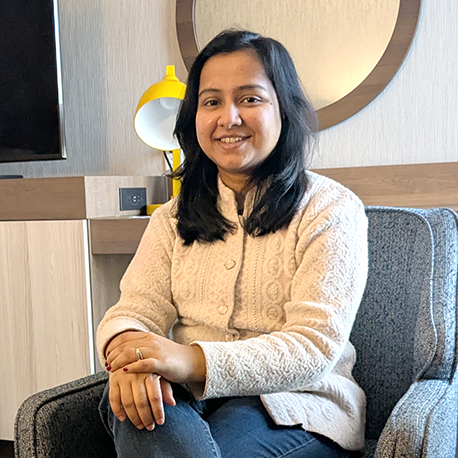
Debapriya Chatterjee, Master of Science in Data Science, Graduate Fall 2026
“As a data scientist with a background in physics, I can now see a problem with the scientific value and the business value. That's the thing I feel changed inside me… As a physicist, I am very good at math, physics, and science stuff, but as a data scientist, now I can fill the gap between the science side and the business side.”
Filling the Gap Between Science and Business
“As a data scientist with a background in physics, I can now see a problem with the scientific value and the business value. That's the thing I feel changed inside me… As a physicist, I am very good at math, physics, and science stuff, but as a data scientist, now I can fill the gap between the science side and the business side.” —Debapriya Chatterjee, Master of Science in Data Science, Graduate Fall 2026
Filling the Gap Between Science and Business
Beginning her career as a physicist, Debapriya Chatterjee realized that the part of her work she enjoyed most was working with data. Inspired to shift her career path, Debapriya enrolled in the Master of Science in Data Science (MSDS) program at the University of Connecticut (UConn). Throughout the program, she has felt guided and supported in walking her chosen path. Debapriya is enjoying the opportunity to directly apply her newly acquired skills and knowledge in building a multimodal dietary recommendation system, and she is excited by the way her broadened perspective enables her to bridge the knowledge gap between science and business.
It was in the context of her work as a physicist that Debapriya’s interest in data science emerged. Debapriya explains, “I did my bachelor's and master’s degrees in physics, and then I worked in India as a research fellow for three years. I was working with experimental datasets, cleaning and analyzing them, and using statistical models to understand patterns in the results. During that work, I enjoyed the data analysis and data modeling type work more than the material science synthesis part. I wanted to shift my career path a little so that I could get the opportunity to analyze more data, not only focused in physics, but across different industries. That’s why I decided to pursue a degree in data science.”
Searching online, Debapriya discovered the Master of Science in Data Science (MSDS) program at the University of Connecticut (UConn). After talking with Jessica Goldfarb, MSDS Program Administrator, she took the leap, relocating across the world to enroll. “When I searched on Google, I found that UConn would give me the flexibility to complete the program in 11 months, or to extend the time if needed. Google helped with a lot of the information, and then I contacted Jessica. We talked via a virtual meeting, and then I decided, ‘Yes, I want to go there.’ So, I moved from India to the U.S. to do my master's at UConn. It's a huge shift, but it's interesting and the learning opportunities are many.” Beginning the MSDS program in August 2025, Debapriya will graduate in December 2026.
Initial intensity helpful
Adapting to life in a new country, Debapriya was initially a bit overwhelmed with the intensity of her coursework but shares how her perspective shifted: “I felt like the first six months were super intense. I even felt like, ‘Why so much homework? I can't do this amount of stress; I can't deal.’ But then I realized that, yes, that was the best part, because I completed all the intense study in the first six months. After that, I have been studying less, so I have time to prepare for my interviews, which is an important part. Applying for jobs is like a full-time job. So, the first six months were intense, but that actually helps me a lot.”
In fact, Debapriya includes the structure of the coursework among the MSDS program’s greatest strengths: “The strongest parts of the program are the structure and design of the coursework, and the homework is so relevant. I like the courses taught by Dr. Joe Johnson, which are really providing all the structure of machine learning, which is so very important nowadays. Also, the statistics course materials are very good. The homework is completely based on real data sets. Apart from the courses, I feel the best part of UConn is the Career Center. They are always there. Also, another big strength is Jessica. She is always there, such as when I was struggling to figure out whether I should finish this program in 11 months. But really for any discussion, Jessica is always there to brainstorm with you or guide you.”
Learning guided by professors
Reflecting on her choice to pursue this degree, Debapriya explains that one of the major advantages of being enrolled in the MSDS program is the guidance and support she receives from faculty and staff. “When changing my career path, I thought about why I needed this degree. As a person new to the field, I'm trying to figure out this new path. It would not be possible for me to cover the entire scope of this learning alone. But in the MSDS program, there are a lot of experienced professors and other people to guide me. They literally help me to walk the path I decided to walk, without getting distracted.”
Another highlight for Debapriya was the opportunity to learn from Prof. Prasanthi Lingamallu in the course OPIM 5605: Data Visualization and Communication. “Prof. Prasanthi is working at Travelers, so I got the chance to talk with someone who is working in a field where I want to go. That was what I enjoyed most: learning directly from someone working in the industry. That course was very enriching because Prof. Prasanthi gave us the idea of storytelling. Whether in an interview or when I am done my project, if I can't explain it with a story, it becomes valueless. So, learning from her how industry works is a very nice thing. Also, I got the opportunity in that course to collaborate with different classmates on a team project. We enjoyed that project a lot.”
Learning the language for interviews
Another course that Debapriya found especially valuable was GRAD 5100: Fundamentals of Data Science because it provided her with the language she needs to effectively communicate her knowledge. “I feel that this course is very much related to the real questions asked in interviews. For example, when I prepare to answer questions about Python for different types of interviews, I can see that, ‘Oh, this is the part I learned in that homework. So, this is very important, and I need to revise that.’ So, I get what I need to land a job from one course, and what I need to be able to do after landing a job is covered by another course. This is really important.”
Applying learning in independent research project
For her last two semesters, Debapriya has been working on an independent research project in the Computer Science Department. She describes the nature of her project: “I am currently focused on building a multimodal dietary recommendation system that will focus on users’ health and goals. Different people have different goals. So, say you are eating soup, you can take a snapshot of the soup and ask the system whether this food is suitable for your health and your goals. The system will tell you whether it is suitable, or which part of the food is not suitable. For example, in a soup with cream, the cream might not be suitable for you, but the soup is. It will give you a proper explanation. So, it is a recommendation system based on using multimodality.”
Working on this project gives Debapriya the opportunity to directly apply the skills she has learned in the MSDS program. “I am using the USDA's data. When I am collecting the data, I am cleaning and indexing the data and deciding which are useful data and which are not. In this entire process, I am applying skills I learned through the program, such as data cleaning and data visualization.”
Further describing the relevance and value of these skills to refining her project, Debapriya continues, “When I am building a system that will generate a recommendation, I need to be able to evaluate whether that recommendation is correct, and if it is applicable to only a small group of people or if it can be generalized to a large amount of people. These are things that I learned through my statistics and causal inference courses. So, I am adding this concept into my current multimodality work. I am applying those statistical concepts that I learned in my courses to prepare a solid output and be able to defend that, yes, this system is applicable to many people. My plan is to publish something, and to build a user interface that people can really use, rather than just letting it stay in a journal.”
Filling the gap between science and business
As she prepares to graduate, Debapriya feels empowered with the new skills and knowledge she brings to the table. “When I graduate with this degree, I can say that I learned statistics, machine learning, and data visualization tasks, and that I not only learned these through course materials, but I applied this learning in my projects. For example, I built a forecasting model using 25 years of daily weather data from ten Indian cities.”
Describing her broadening shift in perspective that has accompanied these new skills, Debapriya continues, “As a data scientist with a background in physics, I can now see a problem with the scientific value and the business value. That's the thing I feel changed inside me. No one understands the F1 score, but everyone understands business matters, such as whether this person is a fraud or not, or whether the company will earn or lose money. Everyone can understand and feel that value. So, as a physicist, I am very good at math, physics, and science stuff, but as a data scientist, now I can fill the gap between the science side and the business side.”
To those considering enrolling in the MSDS program, Debapriya encourages, “UConn is one of the best places to do your master’s degree. The first semester will be tough, but read as much as you can, because that will help you a lot. Focus on the homework and talk with your professors. Don't be shy. Professors are very helpful. They're always there whenever you feel any difficulty understanding something. Whenever I feel like I can't get the point in class, they are always available to help outside of class.”
And to international students, Debapriya adds, “If you are planning to come to the U.S. to do your master's, then mentally prepare to first apply for the internships as much as you can, because most of the internship application deadlines are before you start your courses.”
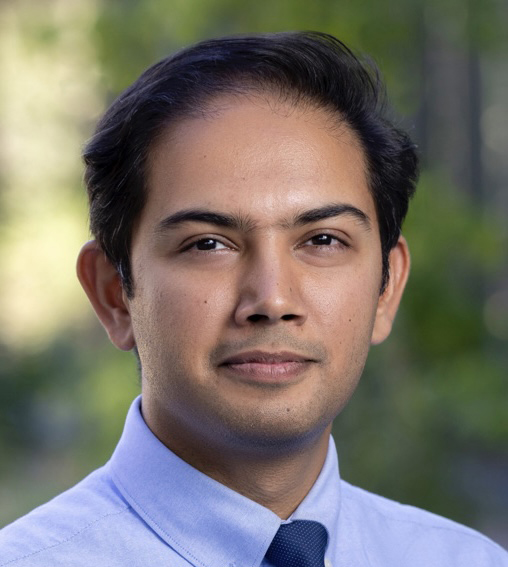
Ghani Haider, Master of Science in Data Science (MSDS), Graduate Summer 2025
“Learning data science and artificial intelligence, especially in this day and age, is very useful going into the future. In the last few years, AI has boomed even more… I believe AI will be the next major shift—augmenting human intelligence and fundamentally changing how we work, create, and solve problems. So, having that skill set is key. It gives you a sense of security, not just for the short term, but for the long term. I think the UConn MSDS degree makes us a little more future proof.”
Marrying Medicine with Data Science and AI
“Learning data science and artificial intelligence, especially in this day and age, is very useful going into the future. In the last few years, AI has boomed even more… I believe AI will be the next major shift—augmenting human intelligence and fundamentally changing how we work, create, and solve problems. So, having that skill set is key. It gives you a sense of security, not just for the short term, but for the long term. I think the UConn MSDS degree makes us a little more future proof.” — Ghani Haider, Master of Science in Data Science (MSDS), Graduate Summer 2025
Marrying Medicine with Data Science and AI
As a doctor and a medical researcher specializing in neuroscience, Ghani Haider is passionate about improving patient outcomes. Ghani’s interest in data science was first sparked in the context of his medical research at Stanford University’s Artificial Intelligence, Machine Learning and Spinal Outcome Laboratory. With the aim of strengthening his skills in statistics and harnessing the power of programming, Ghani enrolled in the Master of Science in Data Science (MSDS) program at the University of Connecticut (UConn). Throughout the program, Ghani valued the challenge of learning new things every day and says the faculty made even the steep learning curves enjoyable. As he continues growing his skills in medicine as well as data science, Ghani is inspired by the possibilities of using AI to improve patient outcomes and now feels empowered with the knowledge and skills to contribute to that ideal.
Driving factors that inspired him
As both a physician and a medical researcher, Ghani’s fascination for neuroscience has been at the epicenter of his work. Ghani explains the nature of his work: “I was intrigued by neuroscience even before I went to medical school because there is so much about the nervous system that we still need to discover and understand. So, my focus after medical school, both while working as a physician and as a researcher, has been in neuroscience and neurosurgery. For a major part of my research, I utilize large databases, artificial intelligence and prediction to study health outcomes, strengthening patient safety and informing health policy. In the other part, I focus on translational research and medical innovation.”
Ghani describes how his interest in data science emerged in the context of his research work at Stanford: “My interest in data science was a bit roundabout and unconventional. I was a practicing physician for almost five years, in Pakistan and then Massachusetts. Then I started doing medical research at Stanford for a couple years. That research involved large data analysis, machine learning, and AI. I was comfortable with the statistics part as I had learned that in medical school, but I wasn't comfortable with the programming part. As a doctor, I hadn't gone to school for that. I was only able to do it by talking to my friends, asking my mentors, studying a little bit online, or working with a master’s students who was studying computer science. That master’s student was just super good at this stuff, and I think that inspired me to pursue this degree. I felt the need to strengthen my statistics skills and to also study programming because it is such a powerful thing.”
Providing an example from his research at Stanford, Ghani elaborates further on why he was inspired to pursue a degree in data science: “We had insurance databases that have data for 35,000 patients who had spine surgery. But it's humanly impossible to study all 35,000 patients to figure out: What are the risk factors for having a bad outcome? Which of these 35,000 patients actually benefitted from these surgeries? By answering these questions, we are able to make better predictions. We can better tailor how we advise patients in the future, and we can identify the ones who may have a bad outcome and tell them that this may not be the best treatment for them. So, those were the most important driving factors that inspired me to get into the MSDS program.”
UConn easy choice
While he did investigate other schools, for Ghani, UConn’s Master of Science in Data Science (MSDS) program was an easy choice. “I think any degree from UConn is considered prestigious. When you are thinking about UConn, you don't need to look up the rankings to be sure it's a great school, you just know it is. UConn has a good name, especially in Connecticut, because it's the largest university. But I've talked to people all across the country, and everybody knows about UConn. It's considered to be a very good school with rigorous academics, and of course, when the basketball team wins, that always helps. So, when we were moving to Connecticut, UConn was the only place I applied. I knew that UConn was a nice place and the education would be good.” Beginning the MSDS program in fall 2024, Ghani graduated in summer 2025, completing the program in just 11 months.
Supportive, friendly faculty
During the first semester of the program, Ghani and his wife welcomed their baby daughter into the world. Thanks to the support of faculty and Jessica Goldfarb, Program Administrator, this major life event did not inhibit Ghani from completing the program on schedule. Ghani explains, “I did shuffle the courses a little bit. Jessica was amazing and helped me through it. I switched one course from in-person to online. Then I moved another course to the summer semester to make that time a little bit easier for me. So, I juggled things around a bit, but almost everybody who wanted to finish in a year was able to do it, and I finished with them.”
Expanding on the high-level of support he felt throughout the program, Ghani continues, “The faculty are all very good at what they do. They're all nice and very friendly. I've sat with Dr. Teitelbaum when I had to ask him for a couple days off, or about how I was going to juggle having a kid with doing my midterm exams in the same week. I remember sitting with him in the cafeteria and having pizza while we were trying to figure this out. I've had walks with Dr. Johnson before and after class, talking about what I should and shouldn’t do when I was looking for jobs. Dr. Spencer helped me in the second semester a lot and even helped me to connect with people. Jessica has been great: before I joined, throughout every day of my degree, and even afterwards. I still communicate with her sometimes. She is very helpful, with ‘We'll do everything that you need.’ Sometimes you don't even know that you need something, but she's already done it. So, the faculty and staff are one of the biggest strengths of the program.”
Rigorous learning every day
For Ghani, the ultimate strength of the program was the challenge and rigor of learning new things every day. “Dr. Teitelbaum, together with the Statistics Department and the Computer Science Department, have created a very good program. Data science is a balance of statistics and computer science, and I think they got that balance right. We would study both throughout the year. They cover a lot, and it's very rigorous. Working as a doctor, I remember thinking, ‘Oh, going to school is not going to be as many hours; it might be relatively easy.’ I knew, of course, we were going to have to study, but oh my, everything was packed. Every week, there was something going on. There were many assignments, which was good. You struggled through it, but you also knew in the back of your mind that this is where you're learning. And you're learning new things every day. That's the biggest strength of the program.”
Professor made challenging learning enjoyable
Despite the disadvantage of not having a background in programming, Ghani says his instructor made learning the material easier. “Once I got there, I realized that the majority of my colleagues had a background in programming. As you might imagine, most people were not doctors. I think I was able to keep going with the classes because I had done some statistics before. I was a little more comfortable with statistics, but less comfortable with the programming part. However, the computer science professor, Dr. Johnson, was wonderful. He made it a little bit easier for me to grasp onto the programming part.”
In fact, it was the computer science courses that Ghani enjoyed most. “I loved the computer science courses. We had Dr. Johnson for both semesters, and just the way he teaches makes the classes really enjoyable. Dr. Johnson knew everyone by name and had formed those relationships. He knew that I was a physician, so if there were any medical problems, he would, in a fun way, pick on me. Or if I didn't understand something, I was fine with asking a question and putting the brakes on everything, and he would stop the class and try to explain it to me in different ways. This also happened with the other students. I think I speak for the whole class when I say we all enjoyed his classes the most.”
Applying learning to a real-world problem
Another especially enjoyable experience for Ghani was the opportunity to apply his knowledge and skills to a real-world problem for his capstone project (GRAD 5800: Applied Capstone in Data Science). “The capstone project was a lot of fun. We got this big data set so we could apply what we had learned. Our dataset was with the UConn Undergraduate Admissions Committee, and the people who were working there were really nice. Using data from UConn admissions, they gave us a very interesting problem: What high schools in the ten Northeast states send the most applications to UConn? What are the factors in those schools? Is it location? Is it urban areas? Is it suburban areas? Is it the social-economic status? I think we had 20 or 30 markers, and then we had data for the number of applications UConn gets from each high school. One of the factors was visits: UConn sends out people for outreach to these schools to meet with high school seniors and talk to them about the university and the different programs. In most cases, you would assume if there were more visits to a school, there will be more applications from that school, but that's not always the case. So, it was a very fun problem to work with. We were divided into groups which were big enough (not too big and not too small), and we worked with colleagues like our friends. We would meet every week with either the undergraduate office or our mentor, and we would check in with them regularly and show them what we did over the previous week. It was so exciting because we mapped out the results. We created a map of the ten Northeast states, and using color-coding, we put the undergraduate admissions from each county on the map. It looked so nice, and the sponsor office and our mentors were so supportive. They would help us tweak things or ask questions to help us get to the right point. It was just so much fun to track a real-world problem. I really enjoyed the capstone project.”
Inspired by possibilities for future
After working on the projects for one of his elective courses, Ghani is now inspired by the many possibilities for using AI to automate processes within his field. “They offer some really exciting electives in the program. The electives were a little bit more complex than the basic courses, but they were very interesting. One elective I took was GRAD 5900: Applied Generative AI. That course was really helpful. Our first project was designing a chatbot. I designed a chatbot who would act as a physician and talk to potential patients and give them information about a certain disease. One of my colleagues was really into hiking, and he designed a chatbot who would talk to people about hiking trails: where to enter, how long and how hard it is, what kinds of snacks to take, etc. Within my field, even I can think of so many exciting things to potentially automate. For example, a doctor can talk to let’s say 20 patients a day about a certain disease. He has to do it repetitively all over again each time, and by the end of it, humans are tired. But I can design a chatbot and deploy it online, and then 5,000 people can talk to the chatbot in two hours: They can ask all their questions and get all their answers. We were taught how to give the chatbot the knowledge to answer all those questions. Then in the end, maybe the doctor has to talk to 5-10 people who still have some questions. But other than that, the chatbot uses that knowledge to help. So, I think there will be so many things that we can't even yet think of that AI will do in the future.”
Straddling multiple domains
When his plans for post-graduation did not materialize as expected, Ghani pivoted back toward medicine, as he continues to cultivate his skills across multiple domains. “I had thought that I would do a master's degree and then go into the corporate world, work in medical research or device development, or even, considering the big insurance industry in Hartford, health insurance. Towards the end of the second semester, I realized that I had interviewed, but nothing had materialized. So then, lucky because I had a medical degree, I chose to apply to a medical residency program. Around that same time, somebody approached me for a part-time position, and it was something that interested me. It involved medical research for developing a brand-new treatment therapy for patients with brain tumors. I wanted to be a part of it, and I told them, ‘I don’t want to let this go.’ I started with them as a consultant in the beginning of the year and absolutely love it. That's something I'm still doing while in the residency program. So, the MSDS program has helped me strengthen my research skills and build my research portfolio.”
Ghani goes on to explain the ways he is already applying his skills in the context of his current roles. “Even in my current jobs, having the knowledge and skill set to be able to do these things helps a lot. For example, in my medical training, I can have computers automatically identify abnormal lab values and send me a message. Let’s say a blood test is done 5,000 times within the hospital. It will tell you how many of these are abnormal. But now I can program the computer to send a message, or call all these patients, or inform a doctor, or send emails, or so many other things.”
Fluid with R and Python
True to his aim, Ghani has greatly strengthened his skills in statistics, including a fluid proficiency in both R and Python. “We studied statistics in medical school, but personally, I wasn't really ever good at that, because I was focused on studying anatomy and how the human body works. People used to joke, ‘Oh, if you came to medical school, math is probably not your forte, so that's why you came here.’ So, statistics wasn't my best. I was just okay with it. When I was doing medical research, I would have to revise it: go back, read again, and then come back to the problem. And even though I did statistics before, I wasn't really fluid with R. Now I can use R and Python just like most people use Microsoft Word or Excel. That helps me in my current roles as a consultant and as a medical monitor. If there is any statistical analysis that needs to be done, I'm now able to do it in a much faster way.”
A little more future proof
Looking to the future, Ghani is awaiting the perfect opportunity that will enable him to bring his diverse skill sets together. “For the long term, I'm still interested in medical research or maybe at some point I'll go corporate. I don't think I want to limit myself to just practicing as a physician. It's good and I enjoy treating patients and helping them. There are certain good feelings that come with that, which don't come with a corporate job, but I think I still want to be involved in research and development. So, I'm still looking for that perfect opportunity where I could marry medicine with AI and data analysis, such as with drug development or therapy development. I'm sort of waiting for the right moment. Sometimes you meet the right people, or you need to go to the right place, or it's just the right time.”
Ultimately, Ghani feels ideally situated with the skills he needs to be successful in a rapidly changing world. “Learning data science and artificial intelligence, especially in this day and age, is very useful going into the future. In the last few years, AI has boomed even more. If you are having a conversation with anybody and they find out that you are studying AI, the most common response is, ‘This is arguably the best time to study AI,’ given how rapidly the field is evolving and the opportunities that presents. I see the evolution of AI as a transformation on the scale of the industrialization and computer revolutions. Industrialization shifted work from physical labor to machines, while computers transformed how we process and manage information. I believe AI will be the next major shift—augmenting human intelligence and fundamentally changing how we work, create, and solve problems. So, having that skill set is key. It gives you a sense of security, not just for the short term, but for the long term. I think the UConn MSDS degree makes us a little more future proof.”

Atharva Bhale, Master of Science in Data Science, Graduate Fall 2025
“I hope to build a career at the intersection of software and data science and AI. I'm particularly interested in roles where I can use data and technology to solve practical business problems and create a meaningful impact. So, one of the biggest things the MSDS program gave me was confidence that I can adapt, learn new technologies, and work across multiple disciplines.”
Building Data-Driven Systems
“I hope to build a career at the intersection of software and data science and AI. I'm particularly interested in roles where I can use data and technology to solve practical business problems and create a meaningful impact. So, one of the biggest things the MSDS program gave me was confidence that I can adapt, learn new technologies, and work across multiple disciplines.”
—Atharva Bhale, Master of Science in Data Science, Graduate Fall 2025
Building Data-Driven Systems
Immersed in a successful career as a software engineer, Atharva Bhale had become increasingly curious about data-driven problem solving. He wanted to learn how to extract insights from data to build better systems. After attending an information session in India, Atharva decided to move across the world to enroll in the Master of Science in Data Science (MSDS) program at the University of Connecticut (UConn). Challenged to think in new ways, Atharva’s learning was enriched by faculty expertise—and extended beyond his coursework alone. The skills he learned in the MSDS program have proven directly relevant to his current work as a Data Scientist and have given Atharva the confidence to continue learning and growing as he builds the career he envisions.
Following his curiosity
It was within the context of his work as a software engineer that Atharva’s interest in data science was initially sparked. As Atharva explains, “I completed my bachelor's degree in Electronics and Telecommunication Engineering in India. After that, I was working as a software engineer for about three years. I started my career with NeosAlpha Technologies, then later moved to Tata Consultancy Services, where I was involved in software development, APIs, enterprise systems, and some data-related workflows. During that time, I became increasingly interested in how organizations use data to make decisions and solve their problems. So, that curiosity eventually led me to pursue a degree in data science. I was keen to learn about data and predictions and machine learning.”
Aligned with what he was looking for
Emphasizing his primary aim, Atharva shares how he decided that UConn’s Master of Science in Data Science (MSDS) program was just what he was looking for: “Coming from an engineering background, I wanted to help myself bridge the gap between building systems and using data to extract some values or insights. I wanted to be able to build systems that are backed with data. That was my main goal. So, while I was still back in India, I joined an information session with Jessica Goldfarb, MSDS Program Administrator. Jessica was describing the MSDS program, and I thought it was really aligned with what I was looking for, so I decided to go with UConn.” Relocating across the world, Atharva began the MSDS program in August 2024, graduating in December 2025.
Learning a different way of thinking
For Atharva, joining the MSDS program involved navigating some challenging transitions, through which he says he grew tremendously: “Moving from India to the United States was a major transition for me, both academically and personally. I had professional experience in software engineering, but data science requires a different way of thinking. It wasn't just about building applications anymore, it was about asking questions, exploring data, validating assumptions, and communicating the findings. At the same time, I was adapting to the graduate school and a different educational environment in a different country. Looking back, that transition challenged me a lot, but it also helped me to grow tremendously.”
Depth of faculty knowledge
From the very first semester, Atharva says learning to think in these new ways was greatly enriched by the depth of faculty knowledge and expertise: “Each professor brought a different area of expertise, which helped me see data science from multiple perspectives. They all had a depth of knowledge in their own field, so it was really fun learning new concepts with them. The Fundamentals of Data Science (GRAD 5100), which was taught by Prof. Jeremy Teitelbaum, was a really good course. It provided a foundation and a direction to move. We also had a data visualization course (OPIM 5605: Data Visualization and Communication) during the first semester. In that course, we learned about Tableau, and how to make insights from data. Coming from an electronics and engineering background, it was very new for me, because I had never used that approach while solving any problems before.”
Confidence approaching open-ended problems
One course has proven especially impactful for Atharva, while still in the program and beyond: “For one of my electives, I chose GRAD 5900: Applied Generative AI (GenAI). After completing the GenAI course, I had the opportunity to join an externship where I applied many of those concepts. It was a really great experience, because I had just learned GenAI in my previous semester, and I directly applied it a month later. During that project, I worked on an AI automation document intelligence system that basically combines some OCR and RAG techniques. The GenAI course included several hands-on projects involving pipelines and RAG architecture, which prepared me well for the externship. Because I had already worked on similar concepts in class, I felt better prepared to contribute during the externship. That experience taught me how to work with real-world data amid ambiguity and with the incomplete, noisy, and messy imperfections that arise in many projects. It helped me become more confident in approaching open-ended problems.”
Accentuating his level of success in the externship, Atharva adds, “The project eventually narrowed from roughly 300 participants to a small final group, and I was fortunate to be selected among the final four.”
Valuable learning beyond coursework
Atharva explains that some of the most valuable skills he learned were through opportunities he engaged in beyond the coursework itself: “A major strength was being able to learn new technologies and work across multiple disciplines. The coursework is important, but some of the most valuable experiences come from the projects, internships, and other activities. For example, as a team, we participated in the Travelers Kaggle competition, and we were in the top 10 finalists in that. All the things we used in that Kaggle competition we learned through the coursework. Also, I was engaged in some leadership activities for graduate students because I was trying to learn new things. I was fortunate to be a part of the John Lof Leadership Academy (JLLA) and the CCE Graduate Student Leadership Initiative. Those experiences helped me develop communication, collaboration, and leadership skills—which I’m currently using in my work as a Data Scientist. I also worked on campus, which gave me the opportunity to interact with students from different backgrounds and become more connected to the university community.”
Foundational skills to be effective
In his new role as Data Scientist with Community Dreams Foundation (CDF), Atharva feels prepared with the foundational skills he needs to be effective in his work. “My experience at CDF allows me to continue applying the skills I developed during the MSDS program, while collaborating with teams and working on real-world challenges. AI and machine learning are becoming increasingly important across industries, so the Generative AI course is helping me to solve problems differently with the help of AI. To be honest, I was using AI before, but not that much. And now AI is basically helping me in my day-to-day tasks. Since the course gave me such a strong foundation, I already know those techniques so I'm more effective in my current day-to-day work.”
Emphasizing the value of some of the non-technical skills he learned in the program, Atharva continues: “As my role evolved, I had the opportunity to coordinate a team of six members. I also deal with multiple department teams: development, marketing, QA, and security. Whenever I get any insight from the data, I have to collaborate with those teams. I already had some experience in software and system engineering, but what I learned at UConn included those leadership and collaboration skills.”
Confidence to learn and adapt
Looking to the future, Atharva feels empowered with the confidence to continue growing and learning as he builds the career he envisions: “I am continuously growing my skills in data science and AI, and exploring long-term opportunities where I can combine my past background and experience with data-driven problem solving. Going forward, I hope to build a career at the intersection of software, data science, and AI. I'm particularly interested in roles where I can use data and technology to solve practical business problems and create a meaningful impact. So, one of the biggest things the MSDS program gave me was confidence that I can adapt, learn new technologies, and work across multiple disciplines.”
To future MSDS students, Atharva strongly encourages: “Be open to opportunities, both inside and outside the classroom. The coursework is important, but some of the most valuable experiences come from the projects, internships, and activities with classmates and faculty. Those experiences can help you grow, not only technically, but professionally and personally as well.”
